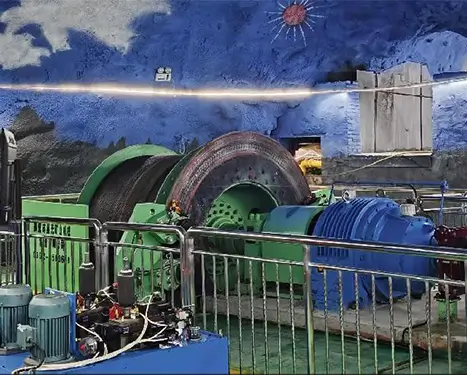
Mine hoist wire rope
Steel wire rope is a primary component of mine hoists; it operates in a complex environment, over long transport distances, and is subjected to bending and alternating loads. Due to the harsh operating conditions—prolonged heavy-load operation, coiling, and physical impacts—steel wire ropes are prone to damage such as fatigue-induced wire breakage and wear. When wire breakage and wear reach a certain threshold, the entire steel wire rope can easily fracture, resulting in significant loss of life and property. Therefore, to effectively prevent steel wire rope breakage accidents, there is an urgent need to develop online detection methods for defects in mine steel wire ropes.
Online detection methods
- To improve the accuracy of online detection of damage in mining hoisting steel wires, an online detection method based on the fusion of magnetic flux leakage detection and machine vision detection is proposed, thereby addressing the accuracy issue in the online detection of damage in mining hoisting steel wires.
- The principle for integrating magnetic flux leakage detection with machine vision inspection is as follows: Two methods—magnetic flux leakage detection and machine vision detection—are employed to perform online identification of wire rope damage. If both methods identify the condition as damage, the wire rope is classified as damaged; if either method identifies it as damage, the wire rope is classified as suspected damage and requires manual verification; if both methods identify the condition as normal, the result is classified as normal. By simultaneously applying both detection methods to identify wire rope damage, the problems of false positives and false negatives associated with single detection methods can be overcome, thereby improving the accuracy of wire rope damage identification.
- In magnetic flux leakage detection, the steel wire rope is first magnetized by an externally applied magnetic field. When the steel wire rope is placed in a magnetic field environment, magnetic flux lines pass through it; these flux lines vary depending on the magnetic field conditions. Since the magnetic permeability of air is far lower than that of steel wire rope, no magnetic flux lines appear on the surface of an intact steel wire rope; when the rope is damaged, the magnetic field strength in the vicinity becomes higher than that in the undamaged area, causing the magnetic flux lines to leak out. A magnetic sensing element detects the magnetic field generated around the steel wire rope, and the intensity of the leakage magnetic field reflects the severity of the damage.
- Machine vision inspection: an industrial camera is used to capture images of the steel wire rope; the images are then converted to grayscale and filtered to reduce noise, thereby improving image clarity and enhancing the features of the steel wire rope; the preprocessed images are subsequently subjected to threshold-based segmentation, which simplifies image analysis and facilitates the identification of areas containing damage or defects, enabling quantitative identification of the damage area and location.
Conclusion
The following conclusions have been reached through theoretical analysis, simulation, and experimental verification:
(1) This online inspection solution employs a combined approach of magnetic flux leakage detection and machine vision inspection to provide comprehensive detection and identification of damage in steel wire ropes, including strand misalignment, corrosion, wear, fatigue cracks, strand jumping and deformation, and surface notches; it also improves the accuracy of damage identification.
(2) Features of wire-break signals in lifting steel wires under different numbers of broken wires were extracted, and quantitative analysis of the wire breaks was performed using GA-BP. The results indicate that, after optimization, the relative error in wire-break identification was significantly reduced, with a maximum relative error of 5.23%.
(3) Preprocessing of images depicting external damage to steel wires was performed using image grayscale conversion and median filtering; subsequently, the regions containing external damage defects in the steel wires were separated and extracted using clustering and morphological operations. The results demonstrate that machine vision can achieve accurate identification of the area of external damage in steel wires.