Overview
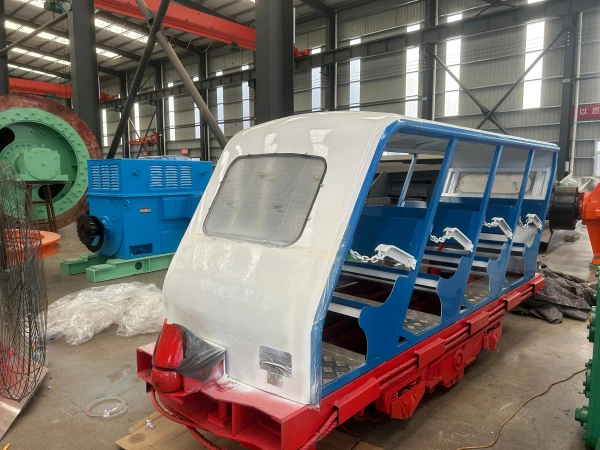
A personnel transport vehicle for inclined shafts is a specialized transportation device designed to ensure the safe and efficient movement of personnel within underground mines and inclined shafts. The vehicle operates on tracks installed within the inclined roadway and is widely used in coal mines, metal mines, non-metallic mines, and various types of underground engineering projects.
The vehicle features a robust steel structure, an advanced braking system, and a comfortable passenger cabin; in the demanding underground working environment, it not only ensures reliable operation but also maximizes operator safety and enhances transportation efficiency.
Main Structure and Operating Principle
The entire train consists of two lead cars (S1 and S2) and a specified number of trailer cars (W), assembled in series using a three-ring chain.
The S1 lead car is towed by the hoist for operation. Each lead car is equipped with: a starting device and a brake fitted with one wheelset.
The device, buffer device, sliding gantry equipped with a wheelset, locking device, and so on; the main tie rod of the two-section lead car
They are connected by a ring chain. Impact buffers are provided between each car to reduce the severity of collisions.
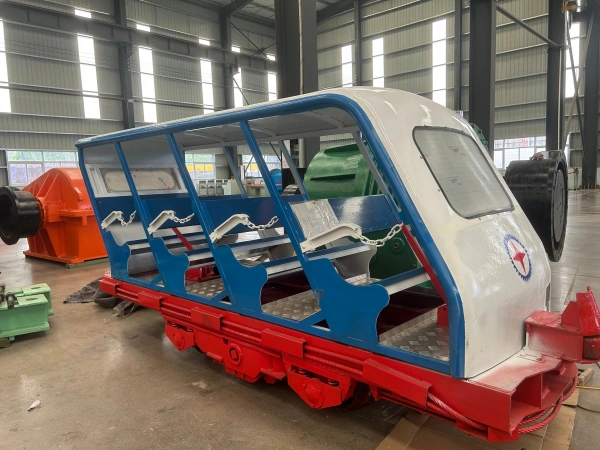
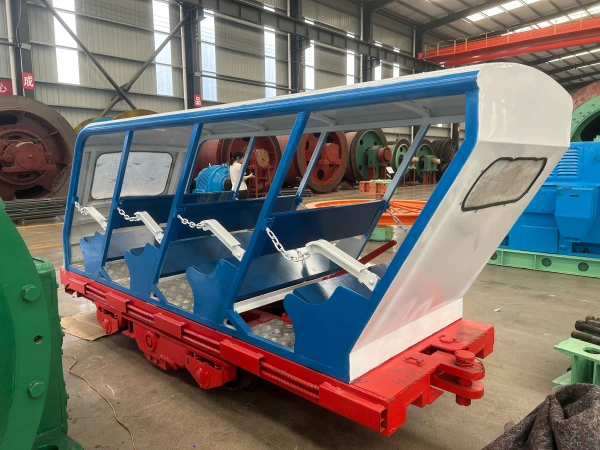
The cab body consists of a canopy frame, chassis, seating, protective chains, observation windows, buffer frames, and other components.
Protective steel mesh may be installed on the sides of the train shed frame as required (for double-hook lifting). At the outer bottom edges of both ends of the shed frame
Weld a butt joint to the end of the plate.
Below the front end of the chassis, near the gear block, there is a removable base plate for the purpose of disassembling and assembling the gear block; beneath the chassis
A guide steel pipe for the passing of a wire rope is welded to the side; the two mounting brackets of the second wheel set are riveted to the underside of the bottom channel steel.
The trailer body consists of a frame, chassis, seats, wheel-set brackets, and other components.
Features
Operational Principle
The inclined shaft personnel vehicle is connected to the hoisting system and travels along the tracks installed within the inclined shaft. Personnel can board the vehicle at designated stations, enabling safe travel between underground and the surface.
During operation, the vehicle is protected by multiple safety systems, including:
- Work braking system
- Emergency Braking System
- Mechanical block device
- Connection device and connection protection mechanism
- Even under demanding operating conditions, these systems can ensure the safety of the transportation process.
Technological Superiority
Enabling rapid movement of workers across different levels, reducing transit time during underground operations, and increasing labor productivity.
Stable operating performance, reliable braking capability, and a robust passenger protection design.
Suitable for shafts with different inclinations; offers multiple passenger-capacity options; and can be customized according to mining requirements.
Long equipment service life, reduced maintenance expenses, and energy-efficient, high-performance operation.
Application
Diagonal shaft personnel transport equipment is widely used in coal mining operations, gold mines, copper mines, iron mines, nonferrous metal mines, underground tunnel engineering, hydropower construction projects, and the development of underground infrastructure.
Parameter
| model | capacity(number of people) | specifications(mm) | maximum angle of inclination(°) | maximum speed(m/s) | vehicle length(mm) | vehicle width(mm) | vehicle height(mm) | weight(kg) |
| XRC-6 | 6 | 600/762/900 | 30 | 4.0 | 3,200 | 1,200 | 1,800 | 1,500 |
| XRC-12 | 12 | 600/762/900 | 30 | 4.0 | 5,000 | 1,250 | 1,900 | 2,500 |
| XRC-18 | 18 | 600/762/900 | 30 | 4.0 | 6,800 | 1,300 | 2,000 | 3,600 |