Overview
Manual sorting remains a key process for recovering high-value materials from waste. This platform is specifically designed for household waste, mixed solid waste, and recyclable materials, balancing efficiency, safety, and comfort.
Product Introduction
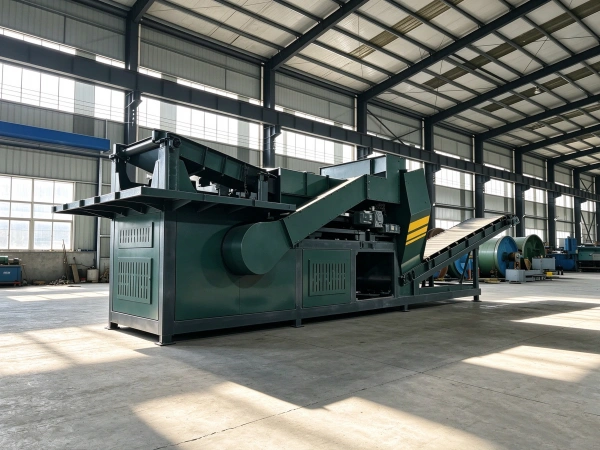
Manual sorting platforms are primarily used in waste-handling lines where mechanical sorting is insufficient. They are mainly employed for screening large contaminants before the trommel screen and as sorting points for recovered materials following air sorting. The sorting platform can be designed according to actual operating conditions, with manual sorting stations installed on both sides of the sorting hopper. During design, it is sufficient to increase the number of workstations and their spacing. Operators can place the sorted materials into the hopper, and the materials will fall into the lower compartment of the double-layer sorting chamber. The lower compartment can be equipped with receiving bins, into which the materials will be discharged.
Operational Principle
Before entering the sorting line, waste is first processed by a bag-disrupting operator to open the bags. The waste is then sorted by particle size through a trommel screen (materials passing through the screen typically constitute residual waste, while materials retained at the top of the screen are larger waste items)
Magnetic separator: removes iron cans and other ferrous metals.
Air barrier: Separates lightweight materials such as plastics and paper from heavier materials such as glass and stone.
This is a critical moment requiring human intervention. Workers stand on both sides of the conveyor belt and sort the materials based on experience and visual inspection.
Safety inspection: Workers remove long ropes, clothing, and large fabrics that may entangle equipment.
Quality sorting: After automatic sorting, staff select materials that do not meet color or material specifications (e.g., mixed PET bottles) to ensure the purity of recyclables.
Features
Parameter
| Parameter Item | Typical Specification | remarksRemark |
| Belt Width | 800 / 1000 / 1200 mm | |
| Sorting length Length | 6–12 m (modular splicing) | |
| Belt Speed | 0.3–0.5 m/s (variable-frequency speed control) | |
| Sorting workstations | 4–10 workstations (bilateral layout) | Based on human resources allocation |
| Motor Power | 3–5.5 kW | |
| Power Supply | 380V / 50Hz (220V,60Hz available upon customization) | |
| Supporting Facilities Accessories | Bilateral LED lighting, emergency stop pull cord, dust cover, negative-pressure dust extraction interface (optional) | |
| Key Features | Modular design, wear-resistant belt, easy disassembly, assembly, and relocation | |
| Applicable Materials | Manual sorting of household waste, renovation waste, and construction waste |